
"How Democracies Die" Revisited - It’s Happening Now
Reading the 2018 bestseller in 2025

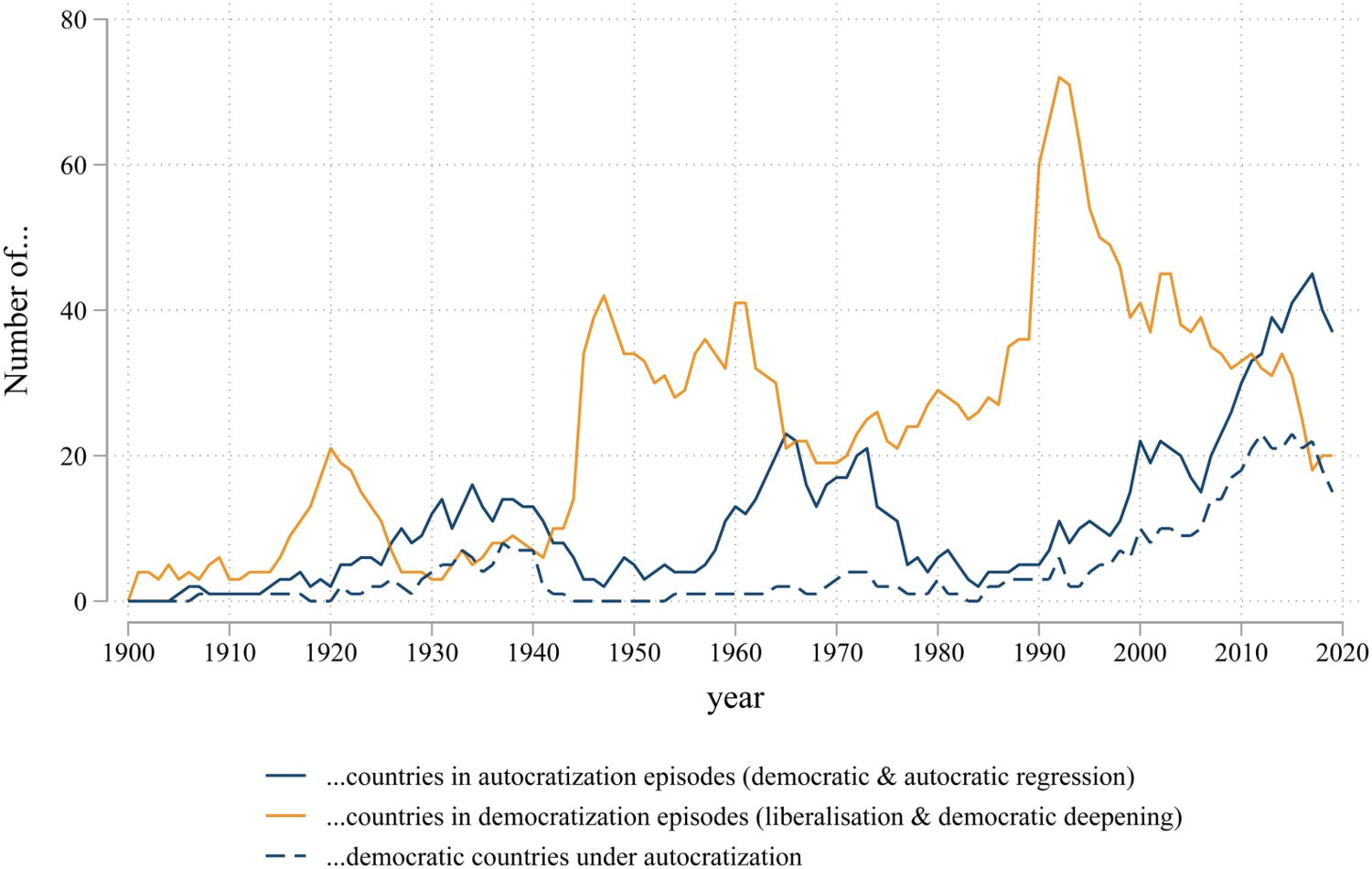
In their 2018 book How Democracies Die, political scientists Steven Levitsky and Daniel Ziblatt identify the warning signs of democratic decline. Their analysis, once a warning, now reads like a ticking time bomb. With Trump back in power, their framework for recognizing authoritarianism is more relevant than ever. Drawing from historical examples, they outline four key indicators of authoritarian behavior: rejection of democratic norms, denial of political opponents’ legitimacy, toleration of violence, and a willingness to curtail civil liberties.
The second Trump administration is already accelerating the authoritarian tendencies Levitsky and Ziblatt warned about—from wide-reaching executive orders to blatant cronyism and an open embrace of political violence. This isn’t theoretical; it’s happening now.
Four Key Indicators of Authoritarian Behavior
Rejection of (or weak commitment to) democratic rules of the game
The first month of the second Donald Trump presidency has been defined by dizzying executive decisions being issued so rapidly that it’s hard to make sense of them all. Ending birthright citizenship, freezing trillions of federal spending dollars, and the indiscriminate purging of federal agencies all signal a radical reshaping of American government, with long-term consequences for immigration, economic stability, and the integrity of civil service institutions. They’re efforts spearheaded by members of his staff (many of whom drafted Project 2025) who are fueled by a belief in the unitary executive theory, an inherently anti-constitutional legal ideology that pushes for a president’s total control over the executive branch without having to answer to Congress or the courts.
Trump’s rejection of democratic norms has been evident since before his 2016 victory. He was the first American president in history to refuse to concede an election, and he was criminally charged with attempting to subvert the electoral results of 2020 (charges that have since been dropped).
Arguably the most antidemocratic feature of the second Trump presidency is the unfettered power that has been given to the richest person in the world. As I write this, Elon Musk and his small team of young engineers have torn their way through USAID, the Department of Education, and the Treasury; the list will continue to grow.
Democracy is not something that Donald Trump or his far-right allies value. He is blatantly authoritarian, even in his own words. As he told a group of Christian voters last July:
“Get out and vote, just this time. "You won't have to do it anymore. Four more years, you know what, it will be fixed, it will be fine, you won't have to vote anymore, my beautiful Christians."
We need to stop assuming that the electoral process will function normally in the 2026 midterms. In 2016, Trump wasn’t prepared to win, and his first term was clunky, violent yet incompetent. This time around, he and agents that wish for an America without democratic guardrails have been devising plans and they have been moving at lightning speed to strip the country of its checks and balances under the guise of washing away bureaucracy. But make no mistake, we are dealing with an explicitly authoritarian administration.
Denial of the legitimacy of political opponents
Trump’s sizable victory in November over Kamala Harris has been weaponized by his administration as a mandate to eradicate any meaningful opposition. One of the most disturbing examples of this is Trump’s signaling that he may prosecute Joe Biden: “The sad thing is he didn’t pardon himself,” he said in a Fox News interview in January. He has directed his Attorney General, Pam Bondi, to investigate the Biden Administration.
Meanwhile, Trump has rescinded the security clearances of many of his adversaries from the past several years, including Alvin Bragg, Letitia James, Mark Milley, one of his former generals who has denounced the president as a fascist, and of course, Joe Biden. His excuse for this is that he doesn’t respect these people, but the message is clear: retribution.
Career civil servants are being dismissed en masse, and agencies that were once meant to function independently—including the Department of Justice and the FBI—are now firmly under the President’s thumb. Trump has always viewed the government as an extension of his personal will, and his enemies as traitors rather than political figures with a right to exist in a democratic system.
This weaponization of government power against political opponents is one of the most clear-cut authoritarian moves in Trump’s playbook. By turning the legal system into an instrument of political vengeance, he has effectively erased the boundaries between party politics and state power.
Toleration or encouragement of violence
One of the most flagrantly corrupt actions taken so far by Trump is the decision to pardon nearly all the J6 rioters that stormed the Capitol Building in his name as one of his very first acts. Many of the pardoned are members of far-right militias such as Proud Boys and Oath Keepers.
This insurrection remains as one of the defining actions of Trump’s political ethos. When faced with electoral loss, Trump didn’t merely defend those who had attempted a coup in his name, but actively supported and helped inspire them. By proving to these militias that he will support them, Trump has created a situation where we could see an increase in white-nationalist led violence against Americans.
And now, with loyalist Hegseth ready to undertake any military whim that Trump wants, we have entered a terrifying new world where a power-hungry leader has near total control of the biggest military in the world. He has deployed troops to the border and has stated that he would use the military against ‘the enemy from within’.
Readiness to curtail civil liberties of opponents, including media
While American media remains vibrant—if increasingly impotent—Trump has begun his crackdown. So far, Trump has focused most of his energy on fulfilling the campaign promises he made; ending Russian aggression in Ukraine (without Ukrainian involvement), upending world trade, and launching an attack on transgender Americans civil liberties. But there have been glimpses of the battles ahead; the Pentagon’s removal of the New York Times from the Pentagon in exchange for the New York Post (a pro-Trump publication), the introduction of a heavy alt-right media presence into White House press briefings, the continuing drama of Trump’s lawsuit against CBS, which now involves the FCC and raises questions of federal oversight of media freedom.
When we start to see increased aggression against American media and enforced curtailing of their First Amendment rights, that will be one of the remaining sirens that mark a complete descent into an antidemocratic state. Last week, AP reported that the White House had blocked its reporters from attending several events and conferences over its continued use of the Gulf of Mexico.
We are dangerously close to the current administration taking steps to restrict the freedom of the press. We've already seen troubling signs of that, and in the coming months there will surely be more. These will be some of the final, most critical tests to gauge whether or not American democracy is all but dead.
Every day brings new revelations about the trajectory Trump's Administration intends to take, not just the country on, but the whole international system. The stunning reversal of support for Ukraine, the rebranding of Zelensky as a dictator, and the return of businesslike relations with Russia all signal a new world order that promotes antidemocratic values.
The question is, what do we do as citizens when it’s clear that these norms are being specifically challenged and trampled upon by an executive branch run amok? Protesting is the most essential action that comes to mind, but there is a real exhaustion in America’s activists right now; compare the size of anti-Trump protests the first time around to now. Police departments are more militarized than ever, and even if mass demonstrations were occurring in the country right now, what could be achieved against a president who is venerated by a large section of the population and who expresses his intent to quell any dissent with the armed forces?
I’m not writing this to remain stuck in doomer limbo, or to imply that there is no course of action. But what is clear is that we cannot rely on the systems that got us into this mess to get us out. The Democratic Party is an organization of elites that refused to meet the needs of the working class and they lost heavily for that. Democrats who have any allegiance to the American people must begin to have frank and open conversations about what is happening, even if it means putting a target on their back and potentially having to leave office to engage in work outside the political system, a system that is proving ineffective at dealing with Trump.
As for the rest of us, we must not let complacency overtake us. There is a surplus of distraction, endless content for us to consume, and it's so much easier to scroll for a couple hours instead of spending more time thinking about how challenging everything seems. This reality that we are all enmeshed in is brutal, disparaging, and has not let up in a long time.
But we are staring down an incredibly dark path for this country, one that could lead to the very worst dystopian scenarios we can imagine; corporatocracy, techno-feudalism, a militarized totalitarian state. We all must confront how possible these outcomes may be, really grapple with the history we may yet find ourselves in so as to prepare, to be primed to meet the moment when it comes.
No one is coming to the rescue. But while institutions may have failed us, our hope lies in grassroots efforts. We have to connect with each other, talk, and begin to organize, even if we have never done it before and don’t know where to begin. I am not an activist, but we are entering an age when passivity becomes tantamount to complicity, when staying silent allows the erosion of our rights and institutions to accelerate unchecked.
In the final chapters of the book, Ziblatt and Levitsky outline several ways in which to resist antidemocratic forces, which include electoral and institutional reforms and the restoration of political norms such as mutual toleration and a redefined cultural relationship to democratic values. These are all things we should keep in our minds, but of the strategies they offer, the most relevant to this moment is coalition-building. They describe coalitions that have been built in other countries made up of businesses, political parties, and social movements that have resisted autocratic leaders in the past.
While we find ourselves in an overwhelming position, confronted with an alliance of entities and actors who wish to suffocate the will of the people for their own benefit, all of us still have agency. So we must fight back with a coalition of our own. Every American who is against fascism and who envisions a country not ruled by the wealthy must unite and act, even if we must begin with small steps. Something as simple as talking with our friends or joining community groups may seem like a drop in the ocean, but we have to start somewhere. Once we do, we trust the path and do what we can with the time that is given to us.
Thanks for reading. Take care.
Phenomenal read. Brings good feelings of comfort and excitement in the depressing chaos we’re witnessing.
https://jacobin.com/2021/08/sunrise-movement-green-new-deal-left-politics-local-organizing thinking of this article on Sunrise’s tactics, and the imitation of civil disobedience movements even if that’s not the most effective strategy.